Death as defiance and communication
Mrs DallowayDeath as defiance and communication names Clarissa Dalloway’s reflection on the death of an unknown young man at her party: she understands it as a possible refusal of oppressive authority and a desperate attempt to communicate across the separations that ordinary life cannot overcome. The idea binds public news to private vulnerability. Death appears at once as an irreversible loss and as a message Clarissa feels compelled to interpret, even as she must return to the living guests gathered in her rooms.
The Death Enters the Party
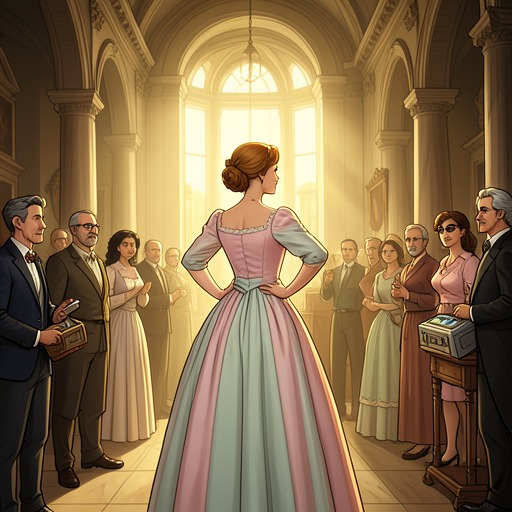
At her evening party, Clarissa learns from the Bradshaws that a young man has killed himself. The news interrupts the gathering’s social splendour: she finds the chairs still marked by the recent presence of the Prime Minister and Lady Bruton, but the room seems suddenly empty, and the party’s grandeur falls away. The juxtaposition makes death more than an abstract subject; it arrives inside the very social occasion Clarissa has worked to create.
Clarissa imagines the manner of the young man’s death, but the narrative gives no meeting between them and no explanation from him. Her response is therefore an act of interpretation rather than knowledge. She asks why he did it and tries to imagine what he experienced, while the fact that she must go back because the rooms remain crowded keeps her reflection in tension with the party’s ongoing demands.
Defiance Against Intolerable Power
Clarissa considers whether the young man had encountered Sir William Bradshaw, whose influence she associates with the power to force a person’s soul. She imagines that, after being impressed by Sir William’s authority, the young man might have concluded that life had been made intolerable by men like him. This is a possibility Clarissa entertains, not a confirmed account of the young man’s treatment or motive; the text leaves the causal link unresolved.
Within that conjecture, death signifies defiance. Clarissa sees the act as preserving something that life, obscured by chatter, corruption, and lies, can let fall or deform. Her interpretation turns the suicide into a refusal of the authority that would impose its account of what counts as a normal life. Yet the act remains irreducible to a political or moral slogan: it is the death of an individual whose inner experience Clarissa can approach only through imagination.
Communication and Isolation
Clarissa’s central insight is that death may be an attempt to communicate. People, she thinks, cannot reach one another’s centre: the closeness they seek draws apart, rapture fades, and each person is left alone. Death seems to her to offer an embrace where ordinary connection fails. This idea makes the act both a message and evidence of communication’s limits; the young man’s death forces others to reckon with him, but it does not give Clarissa direct access to his thoughts.
She wonders whether he died holding fast to something he valued, recalling her own earlier thought, on coming downstairs in white, that dying at a moment of happiness might be complete. The recollection joins the stranger’s unknown experience to a moment in Clarissa’s past without making their circumstances identical. Her question about what he might have carried into death marks the boundary between sympathy and certainty: she can imagine a passion or a preserved treasure, but cannot know what it was.
Clarissa’s Offering and the Return to Life
The idea also illuminates Clarissa’s own response to loneliness. Elsewhere she describes sensing people scattered across South Kensington, Bayswater, and Mayfair, and wishing they could be brought together; the party is her offering, a means to combine and create a meeting point. Its social form is modest and vulnerable, not a cure for isolation. When Clarissa hears of the young man’s death, her belief in connection is tested by the very separation her gathering seeks to bridge.
Her reflection turns back toward memories of Bourton, Peter, and Sally, and toward the knowledge that those people will grow old. She experiences the young man’s death as a private disaster and even as a disgrace, though she did not know him. The intensity of that identification reflects her own awareness of fear and of how much she depends on ordinary companionship: Richard’s presence, and his reading of The Times, can help her recover when she feels overwhelmed.
Clarissa nevertheless returns to the crowded rooms, where people continue to arrive. That movement does not settle whether the young man’s death achieved communication or whether Clarissa has understood his reasons. Instead, the party resumes beside her new awareness of its limits. The contrast gives her interpretation its force: the attempt to gather people against loneliness continues, but it cannot guarantee access to another person’s centre or undo a death.